

Inclusion Through Drama: A Multilingual Play by SENart Students

A play can begin with a blank page, a nervous voice, or a single student wondering whether they are brave enough to step forward. For the SENart students, it began with a shared challenge: create one dramatic piece across three countries, three schools, and three languages, with inclusion at its heart.
The activity brought together students from Fundacion Educativa Corazonista San Jose, Alytaus r. Daugu Vlado Mirono Gimnazija, and Munire Bayer Ortaokulu. Each partner school contributed one third of the play, building a common story through a virtual collaboration. The final work was performed in Spanish, Lithuanian, and Turkish, then recorded and shared with classmates in each school.
What started as a demanding creative task became much more than a performance. It became a lesson in empathy, teamwork, communication, courage, and the power of drama to help every student feel seen.

A shared play built across three schools
Writing a play together is already a complex task. Doing it virtually, across different languages and school communities, adds another layer of challenge.
For this activity, each partner school had to create and develop one third of the play. This meant that no group worked in isolation. Every scene had to connect with the others. Every character, conflict, and message had to make sense as part of a larger story.
The students had to think beyond their own classroom. They needed to ask practical questions:
What story are we all trying to tell?
How can our section connect naturally with the scenes written by the other schools?
What does inclusion look like in action, not just as an idea?
How can we make the message clear for an audience in different languages?
This kind of collaboration asks students to listen carefully. A scene cannot grow if one group ignores the tone or direction of another. A character cannot feel real if each section treats them in a different way. The students had to work as writers, performers, and partners.
The virtual format also gave the project a special value. Students were not only creating for their own classmates. They were creating with peers from other countries. That made the process feel bigger, more responsible, and more meaningful.
The final play became a shared piece of dramatic work, shaped by three educational communities. It showed that inclusion is not only something to discuss. It is something to practise while creating, making decisions, solving problems, and respecting different voices.
Inclusion became a story students could feel
Inclusion can sometimes sound abstract when it stays inside a textbook or a classroom discussion. Students may understand the word, but drama asks a deeper question: What does inclusion feel like?
Through theatre, the SENart students explored inclusion in a more emotional and dramatic way. They did not only speak about the importance of welcoming others. They had to act it out. They had to step into roles, imagine different points of view, and show how exclusion or acceptance can affect a person.
That process matters.
When a student plays a character who feels ignored, misunderstood, or left out, they begin to see that experience from inside the story. When another student plays someone who chooses to help, listen, or stand beside a classmate, they practise the actions that make inclusion real.
Drama gives students a safe space to explore difficult feelings. It allows them to show fear, loneliness, hope, kindness, and courage without turning the activity into a personal confession. The character becomes a bridge. Through that role, students can understand other people more clearly.
The multilingual nature of the project made the message even stronger. The play was performed in each school’s own language: Spanish, Lithuanian, and Turkish. This respected the identity of each group while keeping the same shared purpose. Different languages carried the same central idea.
That is one of the most powerful parts of the activity. Inclusion did not require everyone to sound the same. Each school brought its language, rhythm, and cultural expression to the project. The result showed that a common message can be stronger when it is carried by different voices.

Performing in three languages gave the project real depth
Language was not a barrier in this activity. It became part of the artistic value of the play.
Each partner school performed the work in its own language. Fundacion Educativa Corazonista San Jose performed in Spanish, Alytaus r. Daugu Vlado Mirono Gimnazija in Lithuanian, and Munire Bayer Ortaokulu in Turkish. Each performance carried the shared theme of inclusion, but each one also reflected the students’ own voice and school environment.
This gave students a rich learning experience. They could see that a dramatic message is not limited to one language. A gesture, a pause, a facial expression, a change in music, or a moment of silence can speak clearly even before words are understood.
The students had to think carefully about how to make meaning visible on stage. They worked with:
Voice
Speaking clearly, projecting emotion, and finding the right rhythm for each line.
Body language
Showing relationships between characters through distance, movement, and posture.
Facial expression
Helping the audience understand fear, joy, surprise, sadness, or relief.
Timing
Knowing when to speak, when to pause, and when to let a moment breathe.
Group awareness
Staying alert to other performers so the scenes could flow smoothly.
This is where public speaking and performance skills grew naturally. Students were not practising speeches in a detached way. They were speaking for a reason, inside a story that mattered to them.
Presenting the play to schoolmates also added a real audience. That can be intimidating, especially for students who feel shy or unsure on stage. The moment a student performs in front of peers, they face a common fear: being watched.
Many students discovered that this fear could be managed. Rehearsal helped. Team support helped. Knowing the message of the play helped. By the time they performed and recorded the scenes, they had already taken many small steps towards confidence.
Teamwork carried the play from idea to performance
A theatre project only works when the group works together. One late entrance, one missing prop, one unclear line, or one forgotten technical cue can affect the whole scene.
That made teamwork central to the SENart activity. Students had to depend on one another in practical and creative ways. They were not completing separate worksheets. They were building something that needed every part to function.
Some students focused on acting. Others helped with staging, sound, lighting, recording, or organisation. Some may have felt more comfortable behind the camera than in front of the audience. That variety is one reason drama can be such an inclusive tool in education.
A play needs many kinds of talent:
Students who speak with confidence.
Students who notice visual details.
Students who remember timing.
Students who support classmates quietly.
Students who solve problems when something changes.
Students who bring ideas for music, movement, or atmosphere.
Not every student has to shine in the same way. The performance gives them different paths into the same shared goal.
This also reflects the theme of the play. Inclusion is not only about giving everyone the same role. It is about recognising that people contribute in different ways, and that each contribution can matter.
The students also had to manage pressure. The task was daunting. They had to write, rehearse, coordinate, perform, record, and present their work. They had to do this while carrying the responsibility of representing their section of a shared international project.
Small problems were part of the learning. A line might need changing. A scene might need more energy. A recording might need another attempt. A lighting choice might not work as planned. These moments can be frustrating, but they teach patience and flexibility.
By continuing, adjusting, and supporting one another, the students turned the challenge into a successful performance.

Drama helped students learn beyond the script
The final play was the visible result, but the learning went far beyond the written lines.
Through this project, students developed a wide set of skills. Some were artistic. Some were social. Some were technical. Many will be useful far beyond the stage.
Empathy was one of the clearest outcomes. By acting as different characters, students explored feelings and situations that may not match their own daily experience. This helped them reflect on how words, actions, and silence can affect others.
Public speaking improved because students had to use their voices with purpose. They needed to be heard and understood. They had to control nerves, remember lines, and stay present during the scene.
Teamwork grew through rehearsal and performance. Students learned that the success of the play depended on cooperation. They had to listen, adapt, and trust each other.
Creativity appeared in the writing, staging, and performance choices. Students had to decide how to make inclusion dramatic, clear, and moving for the audience.
Technical awareness also played a role. Recording a play is not as simple as pressing a button. Students explored lighting, music, sound, framing, and audiovisual technology. They saw how technical details can support emotion and meaning.
For example, lighting can make a scene feel warm, tense, lonely, or hopeful. Music can guide the audience’s emotions. Camera position can help viewers focus on the right moment. These are valuable lessons because they show students how art and technology can work together.
The project also gave students a chance to see school as a place of creation. They were not only receiving information. They were making something original, meaningful, and shared with others.
That kind of experience often stays with students because it connects learning to memory. They may forget a simple definition of inclusion, but they are much more likely to remember the feeling of standing with their classmates, performing a scene, and seeing the audience respond.
The audience became part of the learning
Each school recorded its performance and presented it to schoolmates. This step was important because theatre changes when it meets an audience.
During rehearsal, students focus on getting the scene right. In performance, they discover whether the story reaches other people. The silence of the audience, a moment of attention, a laugh, or a thoughtful reaction can help students understand the effect of their work.
Sharing the performances within the schools also spread the message of inclusion beyond the students who took part directly. Classmates who watched the play could reflect on the situations shown on stage. They could recognise behaviours, emotions, or choices from real school life.
A performance about inclusion can open gentle but meaningful conversations:
Who gets left out in everyday situations?
What does it mean to make space for someone?
How can a group notice when someone feels invisible?
What small actions help people feel they belong?
The play did not need to provide every answer. Its strength was in making the audience feel the questions.
That is one of the reasons dramatic arts work so well in education. They invite thought without turning every idea into a lecture. They help students see human situations with more care. They create shared emotional experiences that a school community can talk about afterwards.
The SENart students did more than perform for their peers. They offered them a story about belonging, courage, and kindness. They made inclusion visible.
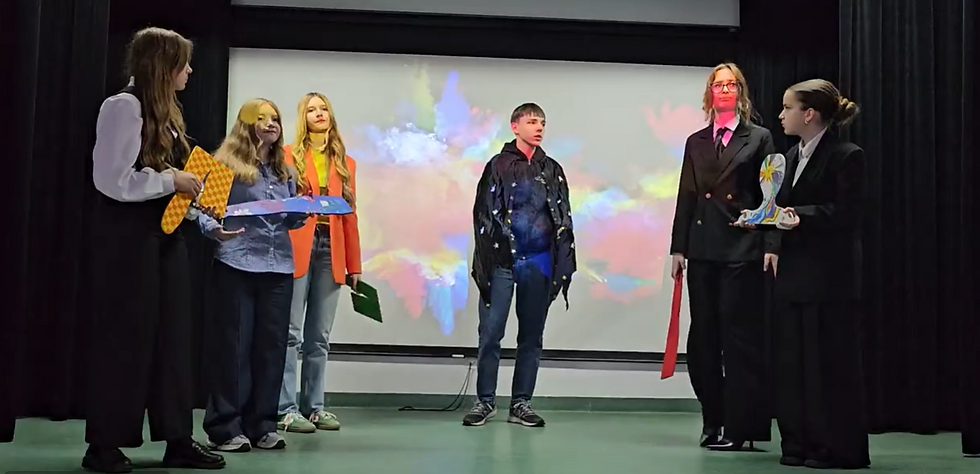
A magical result from a daunting task
The SENart multilingual play asked a lot from the students. They had to collaborate across schools, write part of a shared script, perform in their own languages, use drama to express inclusion, and record their final work for others to see.
At the start, that kind of task can feel overwhelming. It asks students to be creative, brave, organised, and open to teamwork. It asks them to trust their classmates and to believe that their contribution matters.
By the end, the students had created something magical.
The magic did not come from perfect staging or flawless delivery. It came from the process. It came from students overcoming fear, listening to one another, stepping into new roles, and discovering that drama can bring people together.
This project showed that the arts are not an extra part of education. They can be a powerful way to build empathy, confidence, communication, and belonging. A play gives every student a place to contribute, whether through acting, writing, music, lighting, recording, or quiet support behind the scenes.
The SENart students proved that inclusion can be taught through experience. They did not only define it. They performed it, recorded it, shared it, and lived it together.

Comments